

Google Maps Introduces a New 3D Experience: From Flat Maps to Living Cities
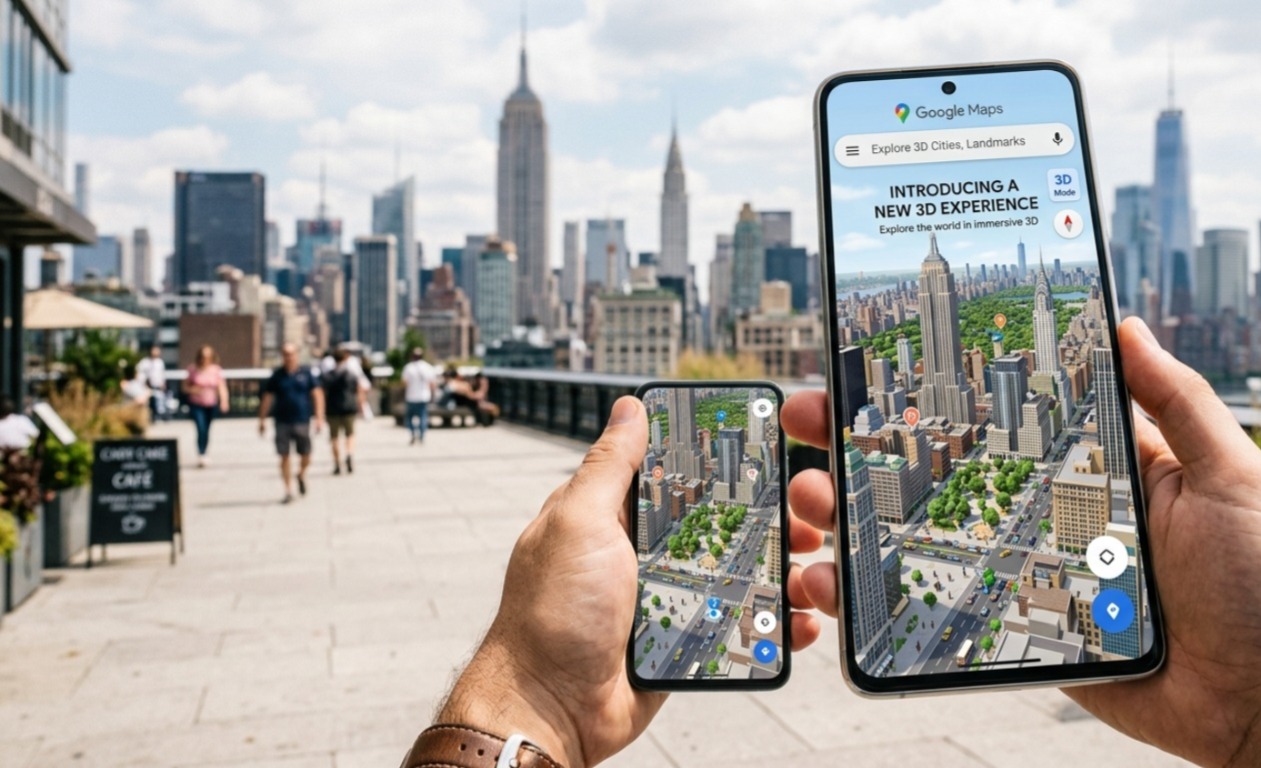
For nearly two decades, Google Maps has been one of the most widely used navigation tools in the world. From helping users find nearby restaurants to guiding drivers through busy city streets, the platform has become an essential part of everyday life. Now, Google is taking mapping technology a step further by introducing a more immersive 3D experience, transforming how users explore cities and locations.
The new update brings enhanced 3D visuals, realistic building models, and advanced navigation features that make digital maps feel closer to the real world than ever before.
A Major Leap in Digital Mapping
Traditional maps typically display locations in a flat, two-dimensional format. While this approach works well for basic navigation, it does not always capture the complexity of real environments.
Google’s new 3D capabilities aim to change that by adding depth, structure, and realism to maps. Users can now view cities with detailed three-dimensional buildings, landscapes, and landmarks.
This development allows people to better understand how places actually look before they visit them. For travelers, urban explorers, and everyday users, the experience becomes more intuitive and engaging.
What the New 3D Features Offer
The 3D upgrade to Google Maps introduces several improvements designed to enhance both exploration and navigation.
1. Realistic City Views
Major cities around the world are now displayed with highly detailed 3D models of buildings and landmarks. This allows users to recognize famous locations and understand the layout of streets and neighborhoods more clearly.
2. Improved Navigation
3D mapping can help users better visualize their routes. Instead of simply following lines on a flat map, travelers can see the environment around them, including tall buildings, bridges, and surrounding terrain.
3. Immersive Exploration
The update enables users to explore cities almost like a virtual tour. You can rotate perspectives, zoom through streets, and view landmarks from different angles, making digital exploration feel more interactive.
4. Better Planning for Trips
For travelers planning vacations or visits to new cities, the enhanced visuals provide a more accurate preview of destinations, helping them understand surroundings before arriving.
How the Technology Works
Google’s 3D mapping relies on a combination of advanced technologies including satellite imagery, aerial photography, and artificial intelligence.
AI algorithms analyze vast amounts of visual data to construct accurate models of buildings, roads, and landscapes. These models are then layered onto Google Maps to create a dynamic, three-dimensional environment.
This technology allows Google to scale its 3D mapping capabilities across many cities worldwide while maintaining visual accuracy.
Why 3D Maps Matter
The shift from flat maps to 3D environments reflects a broader transformation in digital navigation tools. As technology advances, users expect platforms to deliver more realistic and intuitive experiences.
3D mapping offers several key advantages:
- Easier understanding of complex urban layouts
- More engaging travel and exploration experiences
- Improved navigation in dense city environments
- Better visualization of landmarks and surroundings
These benefits make maps more than just navigation tools—they become interactive platforms for discovery.
The Future of Digital Mapping
Google’s move toward 3D mapping also hints at the future of navigation technology. As augmented reality, AI, and spatial computing continue to evolve, maps could eventually become fully immersive experiences.
In the coming years, users may see features such as:
- Real-time augmented navigation overlays
- Live environmental updates integrated into maps
- Interactive city simulations for travel planning
The introduction of enhanced 3D mapping is just one step toward a new generation of intelligent location services.
Conclusion
The transition to a more immersive 3D experience marks an important milestone for Google Maps. By combining artificial intelligence, satellite imagery, and advanced modeling techniques, Google is transforming digital maps into dynamic environments that mirror the real world.
As mapping technology continues to evolve, users can expect navigation tools to become smarter, more visual, and increasingly interactive—reshaping how we explore and understand the world around us.