

From Sci-Fi to Reality: Humanoid Robots Step Into Airport Operations
Introduction
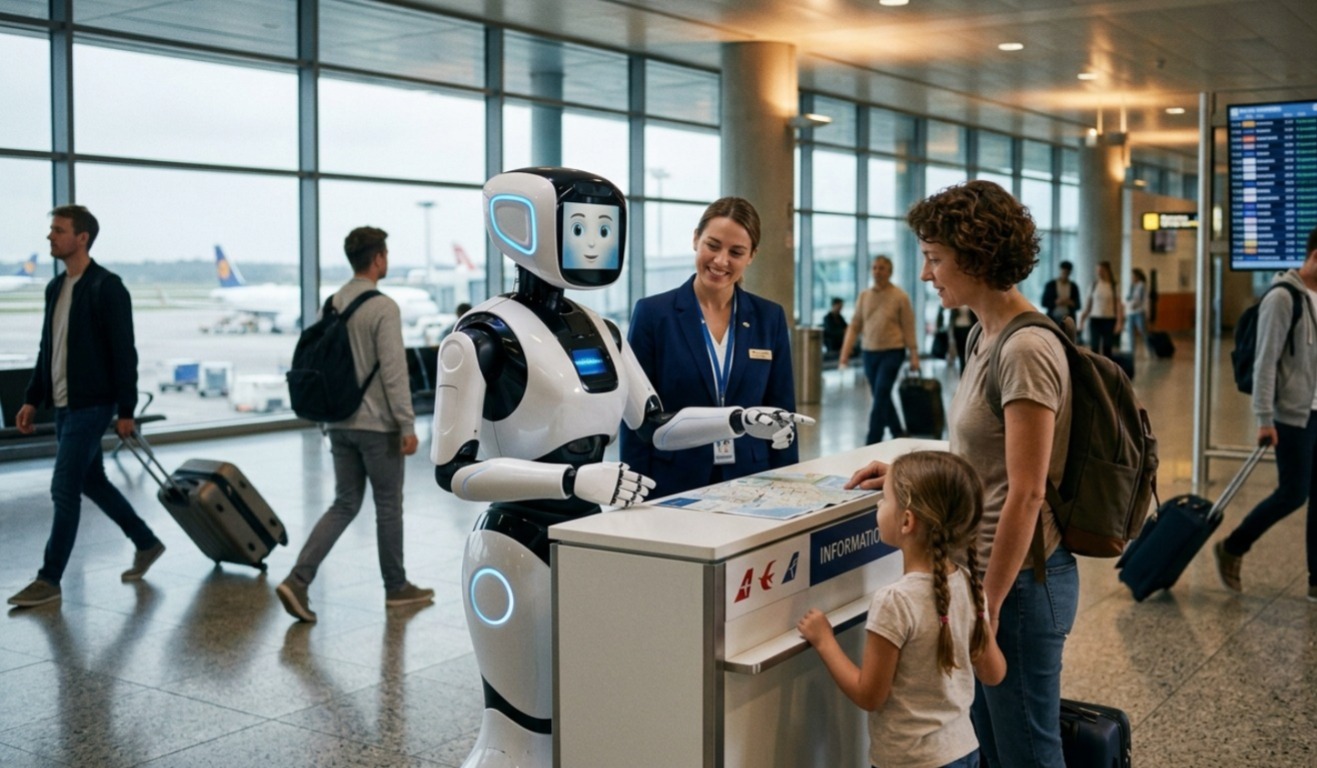
Airports are among the busiest and most complex environments in the world, requiring efficiency, precision, and constant coordination. In a significant technological breakthrough, humanoid robots are now being tested for real operational roles at airports, marking a major step forward in the adoption of robotics in everyday industries.
This development signals a shift from experimental demonstrations to real-world deployment, where robots are beginning to take on practical responsibilities alongside human workers.
The Rise of Robots in Airport Operations
Traditionally, airport tasks such as baggage handling, logistics coordination, and ground operations have relied heavily on human labor. However, increasing passenger volumes and workforce challenges have pushed the industry to explore automation.
Humanoid robots are now being introduced to assist with:
- Baggage handling and sorting
- Transporting items across terminals
- Supporting ground operations
- Reducing manual workload in repetitive tasks
These robots are designed to operate in dynamic environments, adapting to real-time changes and working safely around humans.
Why Humanoid Robots?
Unlike traditional industrial robots, humanoid robots are built to resemble human movement and interaction. This makes them particularly useful in environments like airports where infrastructure is designed for people.
Key advantages include:
🤖 Human-Like Mobility
Humanoid robots can navigate spaces such as corridors, stairs, and crowded areas with greater flexibility.
⚡ Adaptability
They can adjust to different tasks without requiring major system changes.
🧠 AI-Powered Decision Making
With integrated artificial intelligence, these robots can analyze situations and respond accordingly.
Benefits for the Aviation Industry
The introduction of humanoid robots brings several advantages to airport operations:
- Increased efficiency: Faster handling of repetitive tasks
- Reduced labor strain: Assisting workers in physically demanding roles
- Improved consistency: Minimizing human error in routine processes
- 24/7 operation: Robots can work continuously without fatigue
These improvements can help airports manage growing passenger demands while maintaining high service standards.
Challenges and Limitations
Despite the progress, humanoid robots are still in early stages of deployment and face several challenges:
- High development and implementation costs
- Limited ability to handle unpredictable scenarios
- Need for strict safety and regulatory standards
- Integration with existing systems and workflows
Addressing these issues will be crucial for scaling adoption across airports globally.
The Bigger Trend: Physical AI in Action
This development is part of a broader shift toward Physical AI, where artificial intelligence is embedded into machines operating in the real world.
Industries beyond aviation are also exploring similar applications, including:
- Logistics and warehousing
- Manufacturing
- Healthcare assistance
- Retail and customer service
The goal is to create systems that can perceive, think, and act in real environments.
Future Outlook
As technology continues to evolve, humanoid robots are expected to become more capable, affordable, and widely used. Future developments may include:
- More advanced autonomy and decision-making
- Expanded roles in customer service
- Integration with smart infrastructure systems
- Collaboration between humans and robots in daily operations
Airports could become one of the first large-scale environments where human-robot collaboration becomes the norm.
Conclusion
The introduction of humanoid robots into airport operations marks a turning point in the evolution of automation. What was once considered science fiction is now becoming a practical solution to real-world challenges.
While there are still hurdles to overcome, one thing is clear:
the future of work will increasingly involve intelligent machines working alongside humans, reshaping industries and redefining efficiency.