
Riyadh’s Rise as a Global AI Hub
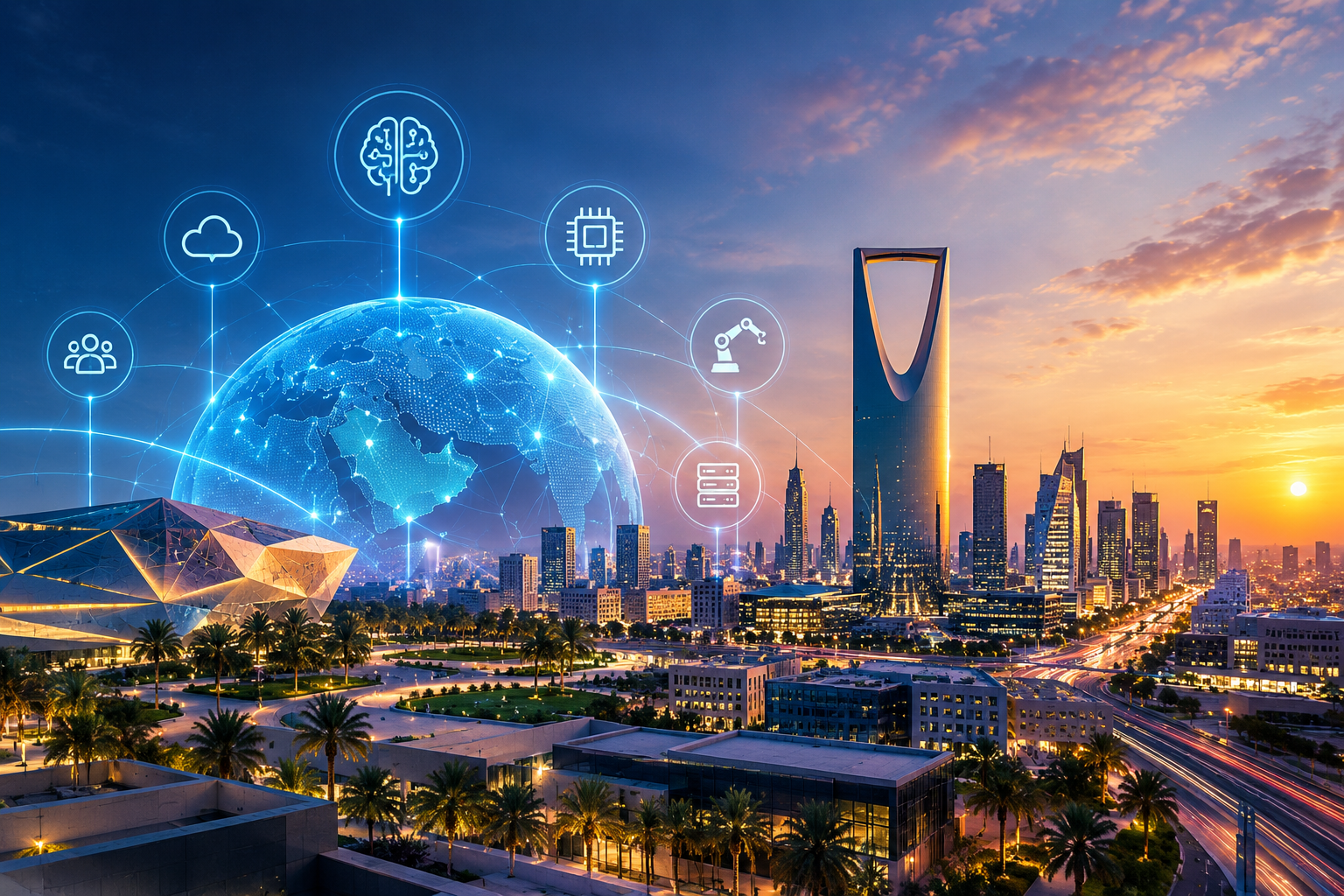
Riyadh is rapidly emerging as one of the Middle East’s most important centers for artificial intelligence, cloud computing and digital innovation.
Major investments in data centers, cloud infrastructure, AI computing and technology companies are reshaping the Saudi capital. At the same time, new initiatives are attracting international technology companies, entrepreneurs and specialized talent.
This transformation is closely aligned with Saudi Vision 2030, which aims to diversify the economy and establish the Kingdom as a global destination for technology and innovation.
A New Digital Innovation District
One of the latest developments strengthening Riyadh’s technology ambitions is the Riyadh Digital Innovation District, launched in August 2026.
The initiative aims to position Riyadh among the world’s top 10 technology hubs, bringing together technology companies, investors, entrepreneurs and specialized talent.
The district will focus on areas including:
🔹 Artificial Intelligence and Big Data
🔹 Cybersecurity
🔹 Cloud Computing
🔹 Internet of Things
🔹 Blockchain
🔹 Robotics and Unmanned Aerial Systems
The goal is to create a dedicated environment where technology companies can develop, collaborate and expand their operations in the Kingdom. (my.gov.sa)
The Infrastructure Behind Riyadh’s AI Ambitions
AI requires substantial computing power, storage and networking infrastructure, making data centers a critical part of Riyadh’s technology strategy.
Saudi Arabia’s operational data-center capacity reached 467 MW in 2026, while the Kingdom is targeting 6.9 GW by 2034.
Riyadh is at the center of this expansion, with major facilities being developed to support cloud computing, AI workloads and the growing digital demands of government and businesses. (my.gov.sa)
A 480 MW Government Data Center
One of the most significant infrastructure projects is SDAIA’s Hexagon Data Center.
The Tier IV facility is planned to reach 480 MW of capacity and cover more than 30 million square feet.
The project is designed to support government data and digital services while providing large-scale infrastructure for advanced computing and AI applications. (spa.gov.sa)
Projects of this scale demonstrate the increasing importance of computing infrastructure to Saudi Arabia’s digital transformation.
Global Cloud Giants Are Expanding
Riyadh’s transformation is also attracting the world’s largest cloud providers.
Microsoft’s Saudi Arabia East Azure region is scheduled to become available in November 2026 and will include three Availability Zones.
Amazon Web Services is also preparing to launch its first Saudi cloud infrastructure region in December 2026, backed by planned investment exceeding $5.3 billion.
AWS and HUMAIN are additionally working toward providing up to 50 MW of capacity within Saudi Arabia’s first AI Zone by 2028. (my.gov.sa)
The arrival of these hyperscale providers gives Saudi organizations greater access to local cloud infrastructure while supporting data residency and increasingly demanding workloads.
HUMAIN’s Role in Saudi AI
Saudi AI company HUMAIN, backed by the Public Investment Fund, is another major component of the Kingdom’s technology strategy.
The company is developing capabilities across AI computing, infrastructure, models and applications.
HUMAIN is also working with AMD and Cisco on advanced AI infrastructure, with plans targeting up to 1 GW of AI infrastructure in Saudi Arabia by 2030. (thenationalnews.com)
Its development gives Saudi Arabia a locally based organization focused specifically on scaling AI capabilities and commercial applications.
Billions in Technology Investment
The scale of investment flowing into Saudi technology is another indicator of Riyadh’s growing importance.
At LEAP 2026, nearly $15 billion in investments and agreements were announced across AI infrastructure, data centers, cloud computing, technology manufacturing and venture capital.
Among the announcements were:
🔹 Microsoft’s Saudi cloud region
🔹 AWS’s planned Saudi cloud region
🔹 Expansion of Al Moammar Information Systems’ data centers
🔹 An $800 million investment in Khuzam Digital Valley
🔹 New AI infrastructure partnerships involving HUMAIN (my.gov.sa)
These investments are helping accelerate the development of Riyadh’s technology sector while attracting international companies and capital.
Why Riyadh Matters Regionally
Riyadh’s ambitions extend beyond the Saudi market.
The capital sits at the center of a region connecting Asia, Europe and Africa, while Saudi Arabia’s expanding cloud and data-center infrastructure provides the computing capacity needed for increasingly digital economies.
As companies across the Middle East adopt AI, cloud computing and automation, Riyadh has an opportunity to become a regional base for technology companies and AI-enabled services.
The Vision 2030 Connection
Riyadh’s technology transformation supports a central objective of
Vision 2030: building a more diversified, innovation-driven economy.
Technology investment can contribute to new industries, highly skilled employment, entrepreneurship and greater productivity across traditional sectors.
AI is particularly significant because its applications extend across government, finance, healthcare, energy, logistics, manufacturing and other industries.
What Comes Next?
The next few years will be important for Riyadh.
New cloud regions are coming online, large-scale data centers are being developed, AI computing capacity is expanding and dedicated technology districts are taking shape.
The challenge will be turning this investment into sustainable companies, commercially successful AI applications and long-term technological capabilities.
If Riyadh succeeds, its role could extend beyond being a major regional technology center to becoming an important participant in the global AI economy.
Final Thoughts
Riyadh’s emergence as an AI hub is being built on several concrete developments: large-scale computing infrastructure, global cloud investment, local AI companies, technology districts and talent development.
From the 480 MW Hexagon Data Center to Microsoft’s Azure region and AWS’s planned Saudi cloud region, the city is rapidly strengthening the infrastructure needed for the next generation of digital services.
The bigger opportunity lies in what comes after the infrastructure is built—using that capacity to develop companies, applications and technologies that can compete beyond Saudi Arabia.
Riyadh is not simply preparing for the future of AI—it is investing in the infrastructure and capabilities needed to help shape it. 🇸🇦🤖